Washington State Customers!
Please be advised that our new software was not giving us the correct sales tax rates on your invoices. As a temporary fix, we have forced our shopping cart to tax all WA State invoices at 9.5%. We will manually look up your rate and your final invoice will be charged the correct tax rate for your shipping address. We apologize for this confusion and hope to have it resolved shortly. Thanks for visiting systemthree.com
WA State Sales Tax
January 20th, 2010High-performance Coatings for “Do-It-Yourselfers”
January 15th, 2010Over the last thirty years, chemical product manufacturers have had to meet tremendous challenges. Two of these with huge impact are regulatory requirements and, less prominent, but with greater long-term effects, changing customer attitudes. System Three Resins, a manufacturer of polymer products in the marine industry for over twenty-five of those thirty years, has met those challenges. And one area where we feel we’ve done better than most is marine coatings.
Historically, paint for priming and finishing boats has been solvent-borne. Over the course of our existence, we have seen the number and variety of products increase dramatically, due to customer demands for quality and performance. In addition, because of improvements in coatings technology, the ability of the manufacturers to respond and produce them has grown also. But even though we’ve seen tremendous changes and improvements across the board, one property has remained the same: marine coatings continue to be solvent-borne.
This means that the toxicity and flammability of these products, due to their solvent content, has not improved. For professionals this hasn’t presented a problem, because they have the skill, equipment, and locations to use solvent-borne products successfully. On the other hand, for the amateur boatbuilder, boat owner, or “do-it-yourselfer,” lack of the same traits and conditions has made the non-professional’s options of ways to paint his or her boat very narrow. In addition, because professional painting operations and painters represent the overwhelming majority of the paint volume consumed, coating manufacturers have done little or nothing to service the amateur or do-it-yourself market with high-performance, long-lasting products.
The amateur’s choices are limited to single-component alkyd-modified urethanes, pigmented and clear, and he’s forced to use even these outside. This means that to get high-performance, long-lasting paint on his or her boat, the amateur is essentially forced to have it applied by a professional. There’s also little reason for optimism on the horizon.
From the beginning, System Three has looked at the amateur boatbuilder and owner as very important customers. The slogan we adopted, “Boatbuilding Launched Our Company,” is absolutely true. In keeping with this spirit we developed high-performance, two-part, low-hazard coatings for the do-it-yourself boat builder or owner. The initial product offerings, in 1992, were introduced after two years of formulation and testing, and represented the best technology available at that time.
Our paint products consisted of a two-part, waterborne epoxy primer, and a two-part, waterborne polyurethane topcoat(LPU). These two products still exist today, with a long track record of successful application by first-time, and many repeat, users. We believed in 1990 that the do-it-yourselfer deserved high-performance marine products he or she could apply with the skill level and equipment they had, and we believe it today. We’re excited about the improvements in coatings technology over the years since our paint products were introduced. These developments afford us a wide range of options to formulate into coatings that will offer the customer more value and convenience than the ones we manufacture now.
There are a number of new low-hazard coating products currently in development at System Three, and will be introduced as soon as each one is tested and ready in production quantities. Check our WR-LPU paint page for what is available now, and check back here periodically for updates on what’s coming up.
Product Compatibility Questions
January 15th, 2010A common technical question goes something like this: “Will XYZ paint work over your epoxy?” Or perhaps the corollary question “Will your epoxy work over ABC stain?” Our answer, which is almost always the same, often shocks the inquirer: “We don’t know, you’ll have to test it yourself. Here’s how to do it…”.
The obvious reason we offer the above answer is that we likely haven’t tried the combination and besides it is not our responsibility to assure that our products are compatible with those of other manufacturer’s anymore than it is for another manufacturer to determine that his products are compatible with ours. Can you imagine calling the maker of ABC stain and asking if their product works under System Three epoxy?
So, why don’t we select a bunch of paints, stains and the like, for example, and run a series of compatibility tests? While arguably it might seem like a great service to our epoxy customers the only real benefit would be saving the user a little bit of time since any test we would do can just as easily be done by the user of both materials with the same level of confidence. Besides if we publish a list of what works and what doesn’t work then we have assumed the responsibility of keeping such a list current. We would have to make sure that those who obtained an earlier version of the list have current information. How could we possibly notify all those who might be affected when a change occurs?
Compatibility changes can occur for many reasons beyond our control: The maker of ABC stain might change his formula slightly. Perhaps a certain raw material is no longer available and he substitutes another. He might have several plants around the country making the same brand name product all slightly differently to suit local environmental conditions. For whatever reason the ABC stain maker is absolutely under no obligation to notify System Three Resins when such changes occur. Would we not have assumed the liability for a failure when such a change causes a product to fail after we published that it would work?
Would you as our customer be willing to pay a huge premium for our epoxy resins for us to take this responsibly off your hands? The cost of testing and retesting product combinations (how often should we retest, by the way?), publishing the results, notifying users when changes occur and paying for failures when we miss something is not something we will ever do. What it boils down to is this:
We can be responsible to you but we cannot be responsible for you.
The Epoxy Book describes in some detail how to do compatibility tests yourself. These are the same tests that we do when we want to see how two products work together. Testing is not difficult nor are the results hard to interpret: If epoxy bonds to thoroughly dry ABC stain after two days it will still be bonded (absent outside forces) in two years or in twenty years. It does not decide to “let go” after a period of time so long-term testing is not required.
So, when you call or write with your compatibility question remember this: We are being responsible to you when we tell you to check it out yourself.
u-TAH™ Cartridges
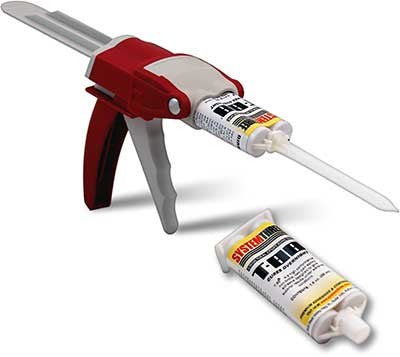
January 13th, 2010Simplicity in epoxy adhesive use has finally arrived! Just drop a System Three u-TAH™ cartridge into a conventional caulking gun, add a mixer tip and squeeze and apply. What could be easier? Only need a little bit and don’t want to use a tip? Then squeeze out some into a cup, mix and apply. In either case the cartridge properly measures the resin and hardener and can never get the ratio wrong. After you’re done put the cap back on and the cartridge is ready to go whenever you next need it. Three different adhesives to choose from: QuickCure 5, T-88 Structural Adhesive, and SilverTip GelMagic.
This cartridge has two chambers, one behind the other. When the back plunger reaches the middle of the cartridge, the cartridge is empty. Here is a flash video from the cartridge manufacturer that explains how it works: TAH Industries u-TAH Video (flash)
u-TAH is a trademark of TAH Industries, Inc.
Postcuring
January 13th, 2010Background
Years ago boat building epoxy resins were generally formulated for wooden boats. Prior to the advent of epoxy resins wooden boats were built using “traditional” methods such as carvel planking, caulked plank on frame, lapstrake, etc. In the mid 1970s Meade Gougeon and his brother, Jan, showed that wood veneers could be glued with epoxy resin and, more importantly, that wood could be protected from moisture egress by coating all exposed sides with epoxy resin. This use of epoxy resin made monocoque (single piece) hull construction possible. These hulls can be constructed using veneer, wood strips and the like and the effect of water on these materials could largely be ignored so long as they were epoxy coated (using fiberglass where appropriate) and maintained so as to keep the epoxy coating intact. Wood/epoxy hulls generally require no more maintenance than all fiberglass hulls. Since traditionally built hulls partially rely for their watertight integrity on wood getting wet and swelling; they can have significant maintenance problems.
One of the chief requirements for epoxy resins used in wooden boat building is that the resin cure sufficiently at room temperature and that the resin system retain enough flexibility and resiliency so that the epoxy coating does not crack from impact during normal use. Epoxies formulated with these properties paramount generally become quite flexible and rubber-like at temperatures in excess of 145ºF. It can be said that their modulus (a measure of stiffness) has dropped sufficiently so that their behavior has changed from glass-like to rubber-like. While tensile, compressive, flexural, and shear strengths have dropped significantly at this temperature, they are still sufficient to bond wood together. The coating qualities of the epoxy are largely unaffected. Obviously, one should carefully choose a painting scheme when completing a wood/epoxy boat to minimize the effects of heat – any color you like so long as it is light (save the dark for accents on hull and cabin sides).
The strength and stiffness of a wood/epoxy boat primarily comes from the wood. The role of the epoxy is to hold the wood together and to protect it from moisture. Except for strip planked and the “corners” of stitch and glue boats epoxy/fiberglass laminates add little to the overall strength of wooden boats. Strip planked boats generally have fiberglass sheathing on both the inner and outer hull sides. Here the epoxy/glass laminate holds the planks in a fixed position relative to each other so that the hull is strong. For a boat built this way to break it is necessary to shear the fiberglass laminate from the wood. Stiffness results from two layers of fiberglass cloth (parallel planes) held a fixed distance apart (I-Beam). Still, the wood strip core adds significantly to the overall stiffness and strength of the boat. A boat built this way could be thought of as a “wood-cored fiberglass boat”. Standard room temperature cured boat building epoxies are perfectly adequate for this construction because the wood takes the load.
But, what happens when the core has little strength or stiffness – a balsa or foam cored boat for example? Here, unlike the “wood-cored fiberglass boat” described above, the skins (epoxy and fiberglass laminates) take the entire load. This significantly changes the requirements of the epoxy resin used in the laminates.
Resin Properties
In foam or balsa cored epoxy/fiberglass laminate boat the skins must take the load – the core has little strength or stiffness. A load on the hull (falling off a wave, for example) will generally put the loaded side laminate in compression and the opposite side in tension. Like rope, reinforcing fabrics are great in tension but poor in compression. It is the epoxy resin that must take the compression load. So, the first requirement of the epoxy here is that it be very stiff so that it does not buckle in compression. Most wood boat building epoxies have sufficient compressive strength for this when at room temperature. However, they rapidly loose stiffness and compressive strength as the temperature rises and, finally, about 145ºF they are totally inadequate and a sufficient compressive load will result in a catastrophic failure – first on the compression and then on the tension side. The laminate literally blows apart. So, the second requirement for this type of construction is that the epoxy maintain adequate compressive strength throughout the expected operating temperature range – generally considered to be up to about 175ºF (higher if the boat will be painted a dark color.)
As the temperature of a cured resin is increased the modulus (a measure of stiffness/resistance to bending) decreases. At first, the decrease is very gradual. As the temperature increases the rate of modulus decrease accelerates. Finally, at some point the rate of decrease hits a maximum and then begins to diminish with further increases in temperature. If one were to graph this with modulus on the vertical axis and temperature on the horizontal axis, both increasing as one moves away from the origin, a reverse “S” shape curve would result. At the point of maximum modulus rate change the curve would change from concave downward to concave upward. The lower temperature end of the curve is where the resin acts as a glass-like material while the resin acts as a rubber-like material. The point of maximum modulus change is called the Glass Transition Temperature (Tg pronounced as “tee-sub-gee”). (This is an important concept so take a break now, reread this paragraph and draw things out.)
One thing should now be obvious: One does not want to “operate” a laminated panel at a temperature above the Tg of the matrix resin. To be safe one wants to have the maximum operating temperature a few degrees below this. The operating temperature is the temperature of the skin laminate, which may be considerably higher than the temperature of the day if sunlight is beating down upon it. (See why light colors are preferred?) Something else ought to be obvious: One wants to use a high Tg resin for these laminates.
What may not be obvious is this: Not only must the resin have “a high Tg capacity” it must be cured at a temperature approaching its ultimate Tg or it will not fully cure. It may get hard enough at room temperature to hand-sand but it will not be fully cured. At some point you must raise the temperature of the laminate to no less than 30ºF of the ultimate Tg for several hours in order for it to fully cure. You can speed things up a bit by going a little over this but doing so will not raise the Tg further. So, the resin system must have the capacity to have an adequate Tg and it must be cured about this temperature. A laminate laid up at room temperature and later heated for ultimate curing is said to be “post-cured”. Note that if a resin system does not have the capacity for a high Tg post curing will accomplish nothing. Wood/epoxy resins generally do not have the capacity to have high Tg’s because the requirements stated above are more important.
Techniques
A high Tg resin may be cured in two ways: It can be cured initially at elevated temperatures or it can be partially cured (becomes solid) at room temperature and then heated (post-cured). The two routes get one to the same place if sufficient time is allowed for both. The first route can be tricky because the epoxy reaction is exothermic and may excessively spike the temperature. Most boats are laid up at room temperature – hand lay up, vacuum bagged or infused – and post cured later simply because this route is considerably easier. This is the one we’ll concentrate on.
Recall the reverse “S” shaped curve above – the one you drew out, right? If a high Tg resin is room temperature hardened at 70ºF it will have a curve slightly to the left of the curve for the same resin hardened at 90ºF. In the case of a high Tg resin system both of these curves are to the left of the ultimate curve. The object of post curing, therefore, is to PUSH the curve to the right as opposed to PULLING it to the right. When it is pushed one stays in the glass-like region of the curve. When it is pulled then one is in the rubber-like region. Since you want to keep the laminates stiff while post-curing stay in the glass-like region. You do this by starting the post curing process at room temperature and ramping up slowly – maybe 10-15 degrees per hour depending upon the size, shape and mass of the part. You can never go too slowly but you can go too quickly. If you go too quickly you will still post cure the part but it may warp in the rubber-like area and take on a permanent set once it has fully cured.
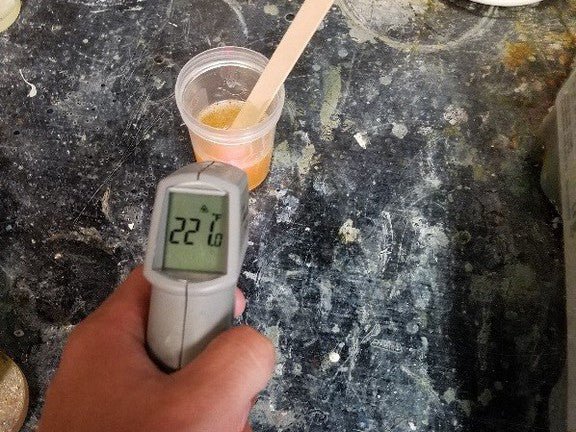
Post curing in a mold may help avoid warping. Waiting for several days at room temperate before post curing helps, also. There are many ways to create a post cure “oven” and none need to be complex since all you have to do is get to 140-150ºF and hold things there for several hours. On a hot July day the back of your minivan will do it for small parts. Ramp up by slowly closing the windows as the morning wears on. Put a thermometer somewhere near the curing part and you’ll control things about as well as the engineers operating the autoclave at the Boeing plant. For larger parts you can rig some black polyethylene sheeting on some ropes over than hull set out in the sun. Put the pointy end of a cheap digital meat thermometer into some kid’s play clay stuck on the laminate. Use a fan to circulate the air in the tent. If you’re inside the barn, tent with clear polyethylene and use a couple of space heaters. Electric is best. Defeat the temperature control and use fans to circulate the air. If you must use direct fired heaters chose propane. Kerosene will fill the tent with unburned hydrocarbons, which may affect secondary bonding. Remember that these heaters use oxygen so you must provide a source. They will create carbon monoxide if there is not enough oxygen so stay out of the tent and provide adequate room ventilation. In larger communities it may be possible to rent these heaters with indirect fire capabilities. These keep burnt gases out of the tent. We once post cured a repair on a thirty-foot spinnaker pole by running the pole through a big cardboard box so that the repair area was inside the box (the pole was on sawhorses). We cut a small hole in the box bottom and inserted a hot air gun nozzle. A lab thermometer stuck in the top provided temperature control. We sat around monitoring things while quaffing a beer or two and talking about the importance of removing the sub forestay before jibing. The points to remember are this. Heat is heat and the epoxy doesn’t give a twit about the source. Monitor the process in some way and stick around to make sure you don’t catch anything on fire. Oh, have a fire extinguisher handy just in case.
System Three at PACE 2010 Show (Feb 8-10)
January 13th, 2010If you are in Phoenix February 8-10, stop by the Convention Center and see Dick Anderson in our booth at the Paint & Coatings Exhibition (PACE). He’ll be in booth #202. He’ll be giving a presentation on Rot Repair during the show as well.
Some information on the show:
Who Attends?
Anyone that works in the paint, coatings and decorating industry, wallcovering professionals; manufacturers; suppliers/vendors; residential; industrial; commercial contractors and business owners; engineering firms; consultants; architects; designers, inspection firms; steel fabricators, state, local and federal DOT; power companies; and anyone who’s in the business of getting business done.
Why You Should Attend
* This is the industry’s premiere paint and coatings show with 300+ exhibits of innovative products, tools and technology to help you succeed.
* Hands-on demonstrations in the classroom and the exhibit hall.
* Learn about the emerging issues and trends facing the industry.
* Meet with peers and share your knowledge.
* Research products you’re not familiar with.
* See the Future…where the industry’s newest innovations, products and services are launched.
For more information on the show, go to www.pace2010.com.
Welcome to our new Website.
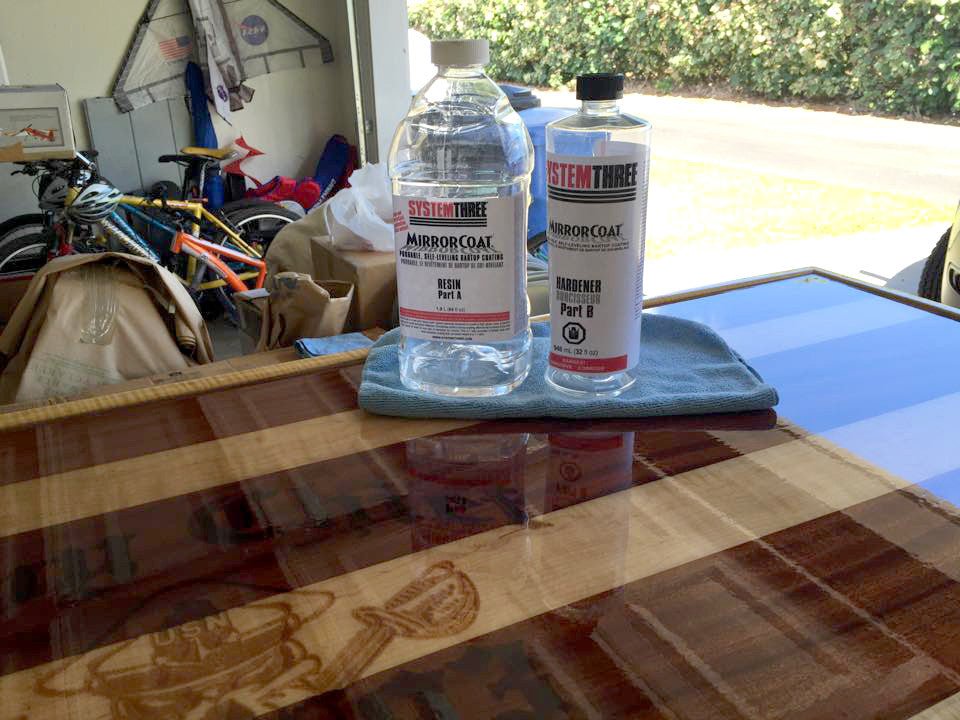
January 10th, 2010Our new site has a wealth of new information. We offer project pages on Rot Repair, Clear Finishing of Outdoor Wood and Using MirrorCoat on a Bar/Tabletop. We have opened up our new ecommerce site, feel free to look around. We’ve updated our Success Stories and will have new posts on our Facebook page as well. Thanks for visiting systemthree.com
Fiberglassing Square Edges
January 5th, 2010Occasionally one needs to bring fiberglass cloth around a sharp edge. This could occur on the trailing edge of a rudder, for example. Those who have tried this know that it is almost impossible to do. The fiberglass is just too “springy” and lifts from the edge creating air pockets. These eventually tear or fill with water. In either case the wooden substrate gets wet and the reason for having the fiberglass there in the first place is lost. While it is possible to keep pushing the fiberglass back down until the tackiness of the resin finally holds it in place there are far better ways to do this.
Method 1
One way is apply a coat of epoxy on either side of the edge an hour or so before applying the tape. Then simply unroll the tape into either side of the tacky epoxy and pull it tightly around the corner. Once it is smoothed out (get it right the first time as it will be impossible to move it around much) it can be wet out with fresh epoxy. This method is tricky for several reasons. The epoxy base has to have the correct tackiness. It has to be placed right the first time. The freshly mixed resin may soften the tacky layer enough to allow the fiberglass to “jump off” the edge. Pressing the tape too far into the tacky layer may make it impossible to thoroughly wet it out — white areas occur. But, if you are doing a bright finish boat or other object this is about the only way to do it.
Method 2
A far better way to do this (but one that only works on a surface that will be painted) is to remove enough of the edge so that the “roundness” starts back about a half-inch from the former edge. Replace the removed material with SilverTip EZ-Fillet, Quik-Fair or an epoxy putty of your own making. Overfill the now rounded edge enough so that it can be block sanded using the two surfaces adjacent to the former sharp edge without leaving voids. Then, once the putty has cured, sand back leaving a “square” edge right where the old edge used to be. At this point one simply applies fiberglass to one surface allowing the glass to overrun the edge by a half-inch or so. Trim this side of the fiberglass right to the sharp putty edge, clean up any drips on the other side of the edge and apply fiberglass to the other side of the edge again allowing a free half-inch overrun. Trim this when cured.
While technically the second method does not involve bending a single piece of fiberglass around the edge it is superior to the first method. The wood is far better protected. A sharp ding may well dent the epoxy at the edge but probably will not break through to the wood. Such damage is easily repaired with SilverTip putty.
10.29.04 @ 6:18pm Malcolm C. of North Vancouver, BC Canada wrote:
Another method is to lay a strip of fibreglass tape saturated with mixed epoxy along and over a sharp edge. Cover the fibreglass tape with a strip of peel-ply (wider than the fibreglass tape) and use adhesive tape to hold down the peel-ply in the dry area beyond the area wet with resin. Remove the peel ply when cured to the “green state”.
Nate Brown Team Builds Raceboat using SilverTip Products
January 1st, 2010The Nate Brown Team built their latest Hydroplane using System Three’s SilverTip Laminating Resin. See the news coverage of Nate and his team building their boat. Nate Brown on YouTube
About the System Three Epoxy Book
December 30th, 2009Welcome to The Epoxy Book by System Three Resins, Inc.
Here you will find a wealth of information regarding the use of epoxy in boat building, wood working, rot repair and more.
If you’d prefer to read/view/print The Epoxy Book in PDF format, you’ll find it at: Resource Library/Published Literature.
Table of Contents
Section I Introduction
Section II Safety and Handling
Section III Understanding Chemistry
Section IV Measuring and Mixing
Section V Boatbuilding Product Evolution
Section VI Our Epoxy Systems
Section VII Techniques of Epoxy Use
Section VII A Coating with Epoxy Resin
Section VII B Fiberglassing with Epoxy Resin
Section VII C Modifying Epoxy with Fillers
Section VII D Bonding with Epoxy
Section VII E Filleting, Fairing and Molding with Epoxy Resin
Section VIII Painting and Finishing
Section IX Areas of Epoxy Use
Section IX A Wooden Boat Construction
Section IX B Wooden Boat Restoration and Repair
Section IX C Composite Cored Construction
Section IX D Fiberglass Boat Repair
Section IX E Other Areas of Epoxy Use
Section X Troubleshooting and Commonly Asked Questions
Appendix A – Estimated Usage
All rights reserved. No part of The Epoxy Book may be reproduced by any method whatsoever without the express written permission of System Three Resins, Inc.
System Three, Quick Cure, Rot Fix, SculpWood and T-88 are registered trademarks of System Three Resins, Inc. EndRot, Phase Two, Clear Coat and SB-112 are trademarks of System Three Resins, Inc.
The information contained herein is believed to be true and accurate. Because the application of the products described in this book is beyond the control of System Three Resins, no warranty of fitness or purpose is made or implied. System Three Resins, Inc. shall not be liable for incidental or consequential damages as a result of the products or applications described herein. System Three Resins, Inc.’s only liability shall be the replacement or refund of purchase price for defective materials. This warranty attaches to and becomes part of the specific warrant of gel coat blister repair in Section VIII-D.